About the article:
China’s leading wine producer, Changyu Pioneer Wine Company, reported a sharp decline in profits for 2025. Net profit fell by 76.6% to about 71.3 million yuan (€8.9 million), marking the first time in over 20 years that profits dropped below 100 million yuan. Revenue also decreased by 8.8% to 2.99 billion yuan (€370 million).
The weak performance was largely driven by a poor final quarter, which saw a net loss of 116.2 million yuan and negative operating cash flow. Wine sales—the company’s core business—fell by over 12%, while brandy sales rose slightly by 2.55%. Changyu attributed the results to a challenging market environment despite efforts to innovate and adjust strategies. One bright spot was the launch of the “Longtail Cat” white wine, which proved popular with younger consumers and generated about 50 million yuan in sales.
In early 2026, the company showed mixed results: first-quarter revenue increased by 8.3% year-on-year, but net profit declined by 6.8%. Changyu aims to reach at least 3 billion yuan in revenue for 2026, though the strong first quarter is partly due to seasonal holiday demand
around the Chinese New Year.
About Meininger:
Meininger publishing group, a long-established German specialist publisher focused on wine, beverages, and gastronomy. It provides news, analysis, and industry insights for professionals such as producers, traders, and hospitality businesses. The platform aims to serve as a central hub connecting the international wine and beverage industry and fostering exchange within the sector.
Gewinne von Chinas Marktführer Changyu brechen ein
Chinas wichtigstes Weinunternehmen, die Changyu Pioneer Wine Company, hat ein schweres Jahr hinter sich. Das zeigt das Geschäftsergebnis zum 31. Dezember 2025, das das Unternehmen mit Sitz in Yantai/Shandong am 18. April 2026 veröffentlicht hat. Demnach sank der Nettogewinn von über 305 Mio. Yuan (umgerechnet etwa 38,2 Mio. €) in 2024 auf lediglich knapp 71,3 Mio. Yuan (8,9 Mio. €) im letzten Geschäftsjahr, ein Minus von 76,6 Prozent. Laut der Branchenplattform Vino Joy fiel der Jahresnettogewinn zum ersten Mal seit mehr als zwei Jahrzehnten seit dem Börsengang unter 100 Mio. Yuan und erreichte den niedrigsten Stand seit Beginn der Aufzeichnungen. Der Umsatz sank im gleichen Zeitraum von 3,28 Mrd. Yuan (410 Mio. Euro) auf 2,99 Mrd. Yuan (370 Mio. Euro), ein Rückgang von 8,8 Prozent.
Besonderen Anteil an dem schlechten Unternehmensergebnis hat das letzte Quartal des Jahres 2025, das einen Nettoverlust von 116,2 Mio. Yuan (14,53 Mio. €) verzeichnet. Hier drehte auch der operative Netto-Cashflow ins Negative, das Unternehmen verlor also mehr Kapital in den letzten drei Monaten, als es erwirtschaftete. Betrachtet man die einzelnen Unternehmensbereiche, sank der Umsatz mit Wein, der mehr als 70 Prozent des Gesamtumsatzes ausmacht, um 12,25 Prozent auf 2,14 Mrd. Yuan (etwa 270 Mio. €). Dagegen stieg der Brandy-Umsatz um 2,55 Prozent auf 759 Mio. Yuan (etwa 94,9 Mio. €) an.
Zusammenfassend hieß es, dass das Unternehmen als Reaktion auf das zunehmend schwierige und komplexe Marktumfeld „mutige Reformen und Innovationen vorangetrieben, kontinuierlich verschiedene Marktstrategien erprobt und dabei gewisse positive Ergebnisse erzielt hat“. Es sei aber nicht gelungen, den Abwärtstrend des Marktes umzukehren und die zu Jahresbeginn festgelegten operativen Ziele zu erreichen. Als positive Produktinnovation hob Changyu den im Jahr 2025 eingeführten Weißwein „Longtail Cat“ hervor, der, wie es das Unternehmen formulierte, „aufgrund seines süßen und weichen Geschmacks sowie seines niedlichen Designs bei jungen Verbrauchern großen Anklang fand“. Der kumulierte Umsatz habe aus dem Stand 50 Mio. Yuan erreicht, umgerechnet 6,25 Mio. Euro.
Nur wenige Tage nach der Bekanntgabe des Geschäftsergebnisses des gesamten Wirtschaftsjahres 2025 veröffentlichte das Unternehmen auch die ersten Finanzzahlen für das erste Quartal 2026 zum 31. März. Hierbei vermeldete Changyu einen um 8,3 Prozent gestiegenen Umsatz von 878 Mio. Yuan (109,78 Mio. €) gegenüber 811 Mio. Yuan (101,41 Mio. €) im Vorjahrszeitraum. Der Nettogewinn fiel dagegen auf 148,5 Mio. Yuan (18,57 Mio. €), verglichen mit 159,3 Mio. Yuan (19,92 Mio. €) im Vorjahr (–6,8%). Als Umsatzziel für 2026 hatte das Unternehmen eine Marke von mindestens 3 Mrd. Yuan angegeben (etwa 375 Mio. Euro). Wegen der 16 Tage dauernden Feierlichkeiten zum Chinesischen Neujahr (17. Februar bis 3. März 2026) fällt das erste Quartal in China für die Produzenten alkoholischer Getränke traditionell stark aus. SP
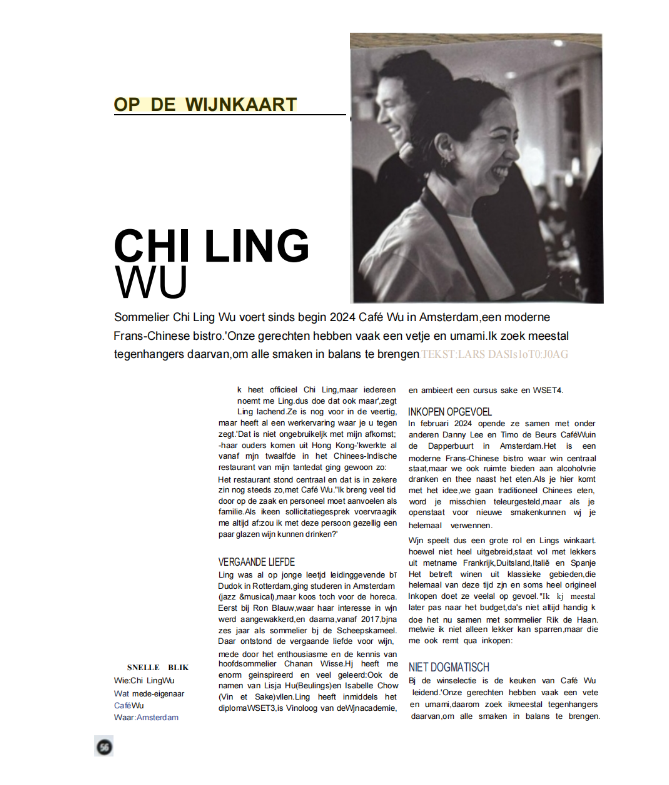
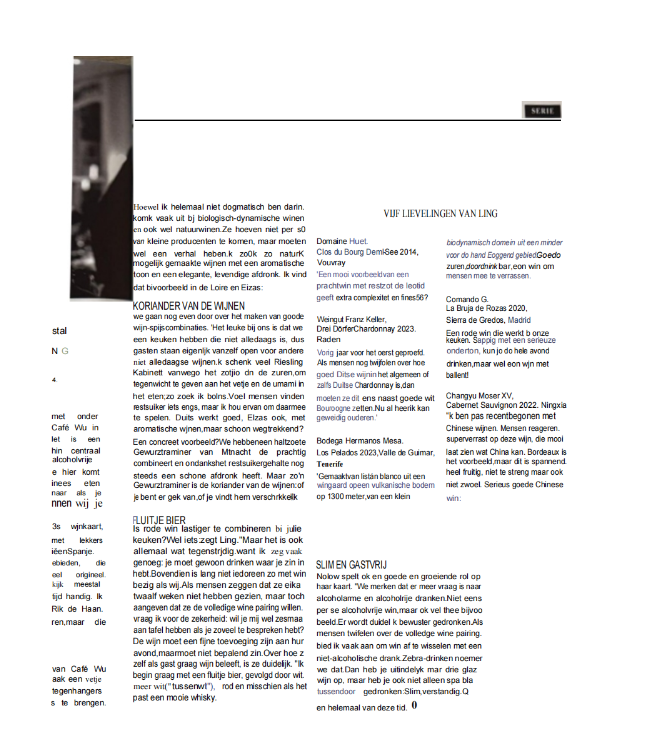
Chi Ling Wu – Sommelier at Café Wu, Amsterdam
Chi Ling Wu (known as "Ling") is co-owner and sommelier of Café Wu, a modern French-Chinese bistro that opened in Amsterdam's Dapperbuurt in early 2024. She grew up around her family's Chinese-Indonesian restaurant and later honed her wine expertise over nearly six years at Scheepskameel.
Wine philosophy: Ling buys mostly on instinct, favoring small-producer, biodynamic natural wines with character — primarily from France, Germany, Italy and Spain. Since the kitchen leans fatty and umami-heavy, she looks for wines that balance those flavors, often reaching for
Riesling or Alsatian whites.
Her 5 favorite wines:
1. Domaine Huet, Clos du Bourg Demi-Sec 2014, Vouvray
2. Franz Keller, Drei Dörfer Chardonnay 2023, Baden
3. Bodega Hermanos Mesa, Los Pelados 2023, Tenerife
4. Comando G, La Bruja de Rozas 2020, Madrid
5. Changyu Moser XV, Cabernet Sauvignon 2022, Ningxia
She's also a strong advocate for alcohol-free alternatives and "zebra drinking" — alternating
wine with non-alcoholic drinks — which she sees as a smart, modern approach to hospitality.
experience.
Wine has always been more than just a beverage. Angelo Gaja describes its role as unchanged even today:"Wine is a symbol of joy,community,and the creation of memories,"says the Italian,considered one of Europe's most influential winemaking personalities.At the same time,it is clear that a new generation is seeking exactly these values—albeit under different conditions:sustainably produced,in harmony with nature, and embedded in a conscious lifestyle.
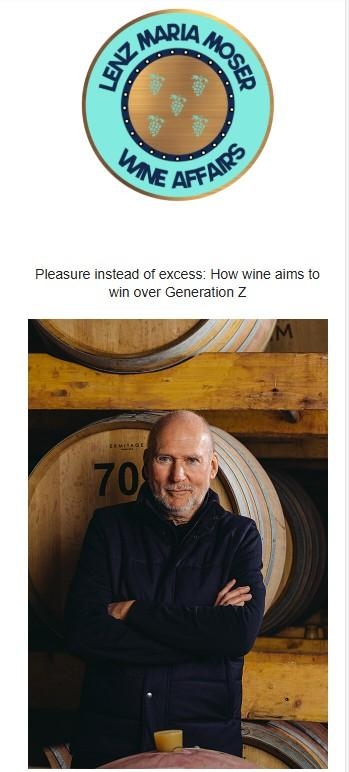
For Lenz Maria Moser, long-time winemaker at Chateau Changyu Moser,one thing is certain:Generation Z has already discovered wine—the industry simply needs to learn how to approach them differently."The younger generation knows exactly what it wants— we just need to offer the right products,"says Moser."It's a bit like technological innovation:you don't just create more of the same,but something that is truly relevant— and suddenly a whole new dynamic emerges."
Values instead of tradition for tradition's sake Insights from recent months clearly show that younger consumers are less interested in
tradition as an end in itself and more focused on values.Transparency,sustainability, authenticity,and a mindful approach to alcohol are at the forefront.
"Wine doesn't need to be 'simplified,"Moser explains."But it must be communicated more clearly,more inclusively,and closer to people's everyday lives."
In 2026,Moser will therefore launch a series of—partly exclusive—masterclasses for younger target groups.The goal is to listen,to understand,and to redefine the language of wine.In doing so,the expert follows a guiding principle that has accompanied him for
decades:"Take away the mystery from wine,but preserve its magic—and educate people."
Innovation as the answer
Chateau Changyu Moser XV is deliberately focusing on products with international appeal: with Long 12(Longyu), the winery has China's most successful premium wine—140,000 bottles sold annually at an average price of around ∈260 underline its position as one of
the country's most important icon wines.
At the same time, White Cabernet (a blanc de noir made from Cabernet Sauvignon)is attracting attention as a unique global innovation—a wine that breaks with traditional categories and specifically appeals to a new generation.
A forward-looking mindset
The central message is clear:it is not enjoyment that is in question—but excess."If people drink less,then every sip must have more meaning,"says Moser.“That is exactly where wine's great opportunity lies."Chateau Changyu Moser XV remains committed to its
ambition to produce wines among the best in the world—while making them relevant for a new generation.